


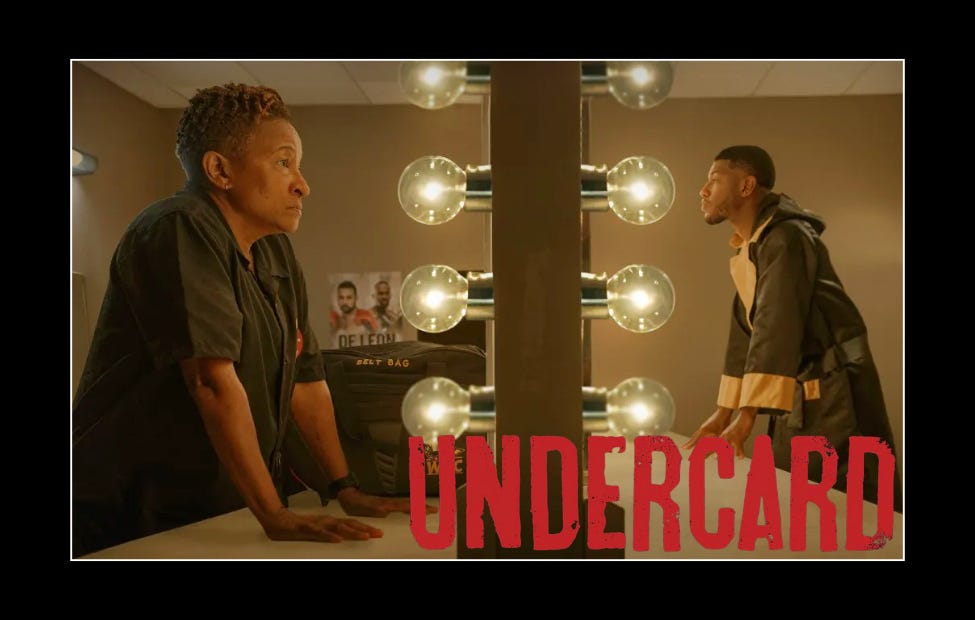
Tamika Miller’s Undercard is a powerful redemption story that captures the tension, unnamed grief, and breakthroughs between a mother and son as they battle lingering maternal trauma, leeching trainers, and the relentless pursuit of rebuilding a fractured family legacy. At the center of this story are Cheryl “No Mercy” Stewart (Wanda Sykes), a recovering alcoholic and former boxing champion, and her estranged son, promising boxer Kieth Stewart (Bentley Green), whose fraught relationship is tested and slowly reshaped through their shared love of boxing. What unfolds is not simply a sports comeback narrative, but a relentless pursuit of a legacy win—one that demands they fight not just opponents in the ring, but the patterns that fractured their family.
At the beginning of the film, Sykes and Green offer a tense and compelling performance as an estranged mother-son duo, beginning with Cheryl’s failed attempt at reconnecting with Kieth outside of Hector’s (Berto Colón) gym, where he currently trains. When Cheryl initiates conversation, Kieth responds, “Listen, you not my momma no more. Grandma my momma, and she’s dead now. You can’t fix 16 years of not being in my life.” This gutting response, paired with visuals of a boxer delivering a knockout on a mural in the background, sets the stage for their contentious relationship. In this moment, the film establishes that the true fight is not for a title belt, but for the restoration of a name, a bond, and a legacy that has already suffered too many blows.
This painful reminder of how she failed as a mother forces Cheryl to channel her grief elsewhere—into a new tattoo by Mariana (Roselyn Sánchez), who also awakens her emotional intimacy through their romantic relationship. Sánchez offers a heartfelt and deeply empathetic performance opposite a mother yearning for closeness and love in a world where she has only learned to communicate through uppercuts and jabs. Their relationship becomes Cheryl’s refuge, suggesting that queer love offers not escape, but the possibility of living beyond both her troubling past and her burdensome present. In the context of the film’s thesis, this love story is not separate from the legacy narrative—it is part of Cheryl’s evolution. Before she can reclaim her family’s name, she must first relearn how to love without armor.
Her growing capacity for love is further emphasized through her guardianship of Meka (Estella Kahiha), her late sister’s daughter. When Cheryl suddenly experiences housing trouble, she works diligently to provide a sense of security and normalcy for Meka—a responsibility she failed to achieve for her own son. Her determination underscores the stakes of this legacy win. Preserving the Stewart name is not about pride; it is about breaking cycles. In protecting Meka from the instability Kieth endured, Cheryl begins to fight differently—not for glory, but for generational repair.
That fight is strengthened by William Stanford Davis’ portrayal of Baba T, who delivers an endearing and grounded performance as a supportive friend and coach. Davis’ tender but firm approach to supporting Cheryl highlights the humanizing nature of the story. Cheryl is not chastised or shamed for being an imperfect mother; she is held accountable and supported through her growth and missteps. Baba T represents stability in a world of volatility, helping Cheryl regain control over her life and protect what remains of her family. His presence reinforces that legacy is not rebuilt alone; it requires community, correction, and care.
The fight to preserve the Stewart legacy intensifies as Cheryl’s defends her family against the formidable training titan Hector (Berto Colón), while Kieth demands accountability from his mother. After a series of unfortunate events leave Kieth injured and incarcerated for a year, Hector offers early release on the condition that he abandons his mother’s training and returns to his gym. Cheryl’s confrontation at Hector’s gym is less about rivalry and more about reclamation. Colón’s character serves as the personification of addiction—he promises validation and fortune, yet slowly corrodes trust and integrity from within. Though Cheryl’s attempt to save Kieth does not immediately succeed, her willingness to fight for him, even when he rejects her, signals her refusal to let their legacy be manipulated or monetized.
When Kieth ultimately realizes that Hector does not have his best interests at heart, the film offers a reconciliation that feels earned rather than convenient. Sykes and Green beautifully capture vulnerability, honesty, and the grief that has long gone unnamed. Sykes proves that her dramatic debut is layered and disciplined, while Green authentically portrays the tenderness beneath the scars—and burns—of a scorned Black son yearning for his mother’s love. Their reconciliation propels the film toward its crescendo—Kieth’s final championship fight with his mother-trainer by his side, as he dons the “No Mercy” name. The moment transcends the question of who wins in the ring; it represents their shared commitment to win each other back. The true championship is not measured by a belt, but by restored trust, reclaimed identity, and a legacy rebuilt through accountability and love.
Undercard lives within and between the space of grief and love, stitching the two together in an inseparable mother-son relationship determined to survive against the odds. It is a quiet affirmation of a mother doing her best and a long-awaited embrace for a son craving love beyond his mother’s capacity. From its intimate close-ups to its charged fight sequences, the film’s visual language mirrors the emotional blows exchanged between mother and son, reinforcing a central truth: the undercard is not the series of fights Kieth and Cheryl endure on their way to a title. It is the internal battles they fight within themselves and with each other to keep their family intact. That is the relentless pursuit. That is the legacy win.
Undercard arrives in theaters February 27.
–Dominique Young // @heyyydommm